 BankRanked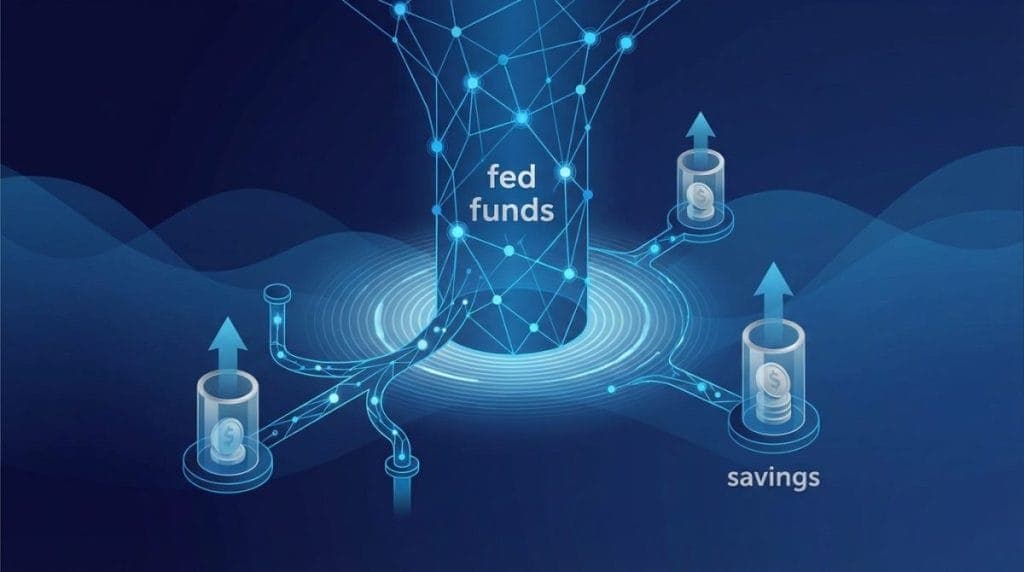
How the Fed Funds Rate Affects Your Savings: Understanding the Connection
BankRanked Editorial Team | AI-assisted, human-reviewed | April 27, 2026
The Federal Reserve’s federal funds rate plays a crucial role in determining how much interest you earn on your savings accounts, certificates of deposit, and other banking products. As of March 2026, the federal funds rate stands at 3.64%, which typically influences the rates banks offer to savers across the country. Understanding this relationship can help you make more informed decisions about where to keep your money and when to move it.
Key Takeaways
- The federal funds rate directly influences the interest rates banks offer on savings accounts and CDs
- Higher fed rates generally lead to better savings rates, though banks may not pass along the full increase
- Rate changes typically take weeks or months to fully impact consumer savings products
- Online banks and credit unions often offer higher rates than traditional big banks, regardless of the fed funds rate level
- Savers should compare rates regularly since banks adjust their offerings at different speeds
What Is the Federal Funds Rate?
The federal funds rate represents the interest rate at which banks lend money to each other overnight. The Federal Reserve sets this rate as a tool to manage economic growth and inflation. When the Fed wants to stimulate the economy, it typically lowers this rate. When it wants to cool down an overheating economy or combat inflation, it generally raises the rate.
Currently, the federal funds rate sits at 3.64%, which reflects the Fed’s monetary policy stance. This rate serves as a benchmark for many other interest rates throughout the economy, including those on savings accounts, mortgages, and business loans.
The Direct Connection to Your Savings
How Banks Set Savings Rates
Banks use the federal funds rate as a starting point when determining what interest rates to offer customers. When the fed funds rate increases, banks can typically borrow money at higher rates, which often translates to higher rates they’re willing to pay depositors. Conversely, when the fed funds rate falls, savings rates generally follow suit.
However, banks don’t automatically match fed funds rate changes dollar for dollar. A bank might increase savings rates by 0.25% when the fed funds rate rises by 0.50%, or they may delay implementing changes for several weeks or months. This variation occurs because banks balance multiple factors, including their need for deposits, competition, and profit margins.
Current Rate Environment
With the federal funds rate at 3.64%, savers are experiencing a significantly different environment compared to the historically low rates of recent years. For context, the national average savings rate was just 0.04% as of March 2021, when the fed funds rate was near zero. The current higher fed funds rate has generally pushed savings rates upward, though the national average still lags behind what many individual banks now offer.
Types of Savings Products Affected
Traditional Savings Accounts
Regular savings accounts typically see the most immediate impact from fed funds rate changes, though the relationship may not be perfectly linear. Large banks like JPMorgan Chase ($3.75 trillion in assets) and Bank of America ($2.64 trillion in assets) may adjust their savings rates more slowly than smaller institutions or online banks.
High-Yield Savings Accounts
High-yield savings accounts, often offered by online banks or smaller institutions, generally track fed funds rate changes more closely. These accounts may offer rates that are 10 to 100 times higher than traditional savings accounts, making them more sensitive to federal policy changes.
Certificates of Deposit (CDs)
CD rates often move in tandem with fed funds rate changes, but the relationship can be complex. Longer-term CDs may be more influenced by Treasury bond yields than short-term fed policy. The current 10-year Treasury yield of 4.3% provides context for how longer-term rates compare to short-term policy rates.
Money Market Accounts
Money market accounts typically fall somewhere between savings accounts and CDs in terms of rate sensitivity. They may offer slightly higher rates than regular savings accounts while maintaining more liquidity than CDs.
Timing and Implementation Delays
When the Federal Reserve changes the fed funds rate, the impact on your savings account doesn’t happen instantly. Banks typically take several weeks to several months to fully adjust their deposit rates. Some factors that influence this timing include:
- The bank’s current deposit levels and funding needs
- Competition from other financial institutions
- The bank’s overall business strategy and profit targets
- Administrative processes for implementing rate changes
Smaller banks and credit unions may move more quickly than large institutions like Wells Fargo ($1.82 trillion in assets) or U.S. Bank ($676 billion in assets), which may have more complex approval processes for rate changes.
Bank-by-Bank Variations
Not all banks respond to fed funds rate changes in the same way or at the same speed. Large national banks may be less aggressive in raising savings rates because they have stable funding sources and may not need to attract as many deposits. Their return on assets (ROA) varies significantly: Goldman Sachs Bank USA shows a 1.42% ROA, while Capital One National Association reports a 0.55% ROA, which can influence their pricing strategies.
Online banks and smaller institutions often compete more aggressively for deposits by offering higher rates that more closely track fed funds rate movements. Credit unions, which operate as member-owned cooperatives, may also offer more competitive rates than traditional banks.
Maximizing Your Savings in Different Rate Environments
Rising Rate Periods
When the Fed is raising rates, savers may benefit from:
- Shopping around for banks that quickly pass along rate increases
- Considering shorter-term CDs that can be renewed at higher rates
- Moving money from low-yielding accounts to higher-yield alternatives
- Monitoring rate changes regularly, as banks may adjust at different times
Falling Rate Periods
When rates are declining, savers might consider:
- Locking in current rates with longer-term CDs
- Being prepared to move money as banks cut rates at different speeds
- Maintaining some funds in flexible accounts for opportunities that may arise
Beyond the Fed Funds Rate: Other Factors
While the federal funds rate significantly influences savings rates, other factors also play important roles:
Economic Conditions
Banks consider broader economic conditions beyond just the fed funds rate. Factors like unemployment, inflation expectations, and economic growth projections all influence their rate-setting decisions.
Bank-Specific Factors
Individual banks’ financial health, growth strategies, and deposit needs affect their rates. A bank experiencing rapid growth might offer higher rates to attract deposits, while one with excess deposits might keep rates lower.
Competition
Local and national competition significantly impacts rates. Banks operating in competitive markets typically offer higher rates than those in areas with limited competition.
Risks and Considerations
While higher fed funds rates generally benefit savers, there are important considerations:
Rate Volatility
Fed funds rates can change multiple times per year, and savings rates may lag behind these changes. Savers who chase the highest rates might find themselves constantly moving money between accounts.
Inflation Impact
Even with higher nominal rates, the real return on savings (after accounting for inflation) may still be negative during periods of high inflation. The purchasing power of your savings could decline even as you earn more interest.
Opportunity Cost
Focusing solely on savings rates might cause you to miss other investment opportunities that could provide better long-term returns, though these typically involve more risk.
FDIC Insurance Limits
Remember that FDIC insurance covers up to $250,000 per depositor, per insured bank, per ownership category. Savers with larger amounts should ensure their deposits remain within insured limits across all their accounts.
Monitoring and Responding to Changes
To make the most of fed funds rate changes, consider:
- Regularly reviewing your savings account rates, particularly after Fed meetings
- Comparing rates across multiple banks and account types
- Understanding any minimum balance requirements or fees that might affect your actual returns
- Keeping track of promotional rates that might expire
The Consumer Financial Protection Bureau (CFPB) provides resources for comparing banking products and filing complaints if you encounter problems with your bank. Banks must respond to CFPB complaints within 15 days, providing an avenue for addressing rate-related concerns.
Looking Ahead
The relationship between the fed funds rate and savings rates will likely continue, but the strength of this connection may vary over time. As financial markets evolve and new savings products emerge, the traditional relationships might shift. Staying informed about Federal Reserve policy, economic conditions, and banking industry trends can help you adapt your savings strategy accordingly.
Remember that while the fed funds rate provides important context for savings rates, individual banks’ decisions ultimately determine what you earn on your deposits. The current rate environment of 3.64% for the fed funds rate represents a significant change from the near-zero rates of recent years, potentially offering better opportunities for savers who actively manage their accounts and compare options regularly.
This article was created with the assistance of AI and reviewed by the BankRanked editorial team. BankRanked is not a bank, credit union, or financial advisor. Content is for educational purposes only.
BankRanked is not a bank, credit union, or financial advisor. All information is provided for educational purposes only using publicly available government data. Always consult a qualified financial professional before making financial decisions.
About this guide
Researched with public federal data, cited inline above. Reviewed by the BankRanked editorial team. Updated when underlying data or methodology changes. BankRanked is not a bank, credit union, or financial advisor; content is for educational purposes only.
This article was created with the assistance of AI and reviewed by the BankRanked editorial team. BankRanked is not a bank or financial advisor. Content is for educational purposes only.